Calculate the complete route
Include empty positioning and every loading, unloading and intermediate leg so the denominator reflects the truck movement being priced.

Convert the complete route economics into comparable euro-per-kilometre values. Review internal break-even cost per kilometre, client rate per kilometre and profit per kilometre using the actual planned distance, including optional empty positioning.
A useful rate-per-kilometre figure must use the complete route distance and complete trip economics. Ignoring deadhead, tolls or time cost can make an apparently profitable rate fall below break-even.
Include empty positioning and every loading, unloading and intermediate leg so the denominator reflects the truck movement being priced.
Add distance-based cost, fuel surcharge, tolls, fixed expenses, driver salary and vehicle time cost.
Use €/km for analysis while still quoting and exporting the full client freight price.
Client rate per kilometre = Client freight price ÷ Complete planned distance; Profit per kilometre = Client rate per kilometre − (Internal transport cost ÷ Complete planned distance)
The final €/km result is only as reliable as the cost and distance underneath it. Use the whole route and include the expenses that the vehicle actually creates.
Use loaded, intermediate and empty positioning kilometres rather than only invoiceable loaded distance.
Distance segments can use different configured rates depending on the country crossed.
A percentage-based fuel adjustment changes the internal cost and therefore the break-even rate.
Road charges, ferries and route-specific costs must be recovered by the selling rate.
Long transit time can increase cost even when the physical route distance does not change.
The selected margin turns the internal break-even cost into the final customer price.
Assume the complete route is 920 km and the internal transport cost after fuel, tolls, time and fixed expenses is €1,196.00. The break-even cost is therefore €1.30 per kilometre.
With a 15% commercial margin, the client price becomes €1,375.40. Dividing that price by the same complete route distance gives a selling rate of approximately €1.50 per kilometre.
| Rate component | Example result |
|---|---|
| Complete planned distance | 920 km |
| Internal transport cost | €1,196.00 |
| Break-even cost per kilometre | €1.30/km |
| Commercial margin | 15% |
| Client freight price | €1,375.40 |
| Client rate per kilometre | €1.50/km |
| Profit per kilometre | €0.20/km |
Rounded values are used for readability. Calculate commercial decisions from the unrounded totals in the active LogicCalc route.
Turn routes of different lengths into a common €/km measure without losing the underlying trip cost.
Understand how empty positioning changes the effective rate across the complete truck movement.
Use €/km for analysis while still quoting and exporting the full client freight price.
Divide the relevant transport amount by the complete planned route distance. Use internal cost for break-even €/km and client price for selling €/km.
For internal profitability, total truck movement is usually the safer denominator because empty positioning also creates cost. Commercial contracts may use a different convention.
Tolls increase internal trip cost. When the same distance remains unchanged, the break-even and required client rates per kilometre increase.
No. Country rates are inputs used to calculate distance-based cost. The final client rate also reflects fuel, tolls, time costs, fixed expenses and margin.
LogicCalc keeps full route totals in the calculation and saved route workflow. Divide comparable totals by complete distance using the same cost assumptions.
This is a real LogicCalc workspace view. Use your own route, cargo, fleet and commercial settings for the actual calculation.
Open LogicCalc →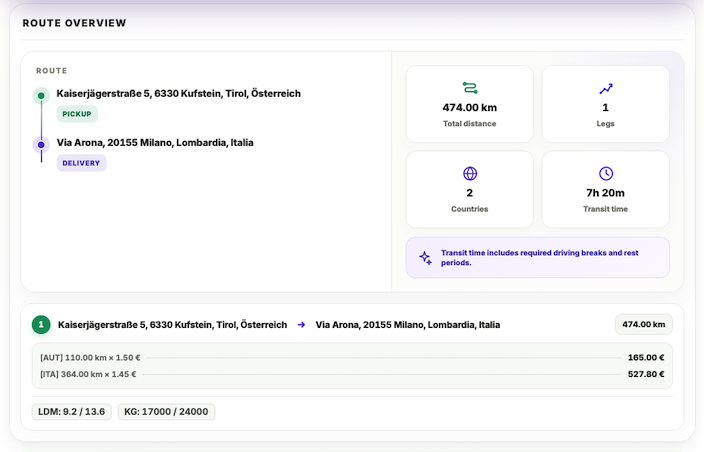
Explore route planning, transport pricing, cargo, driver-time and sustainability tools in one connected workspace.
Build the route, include every relevant cost and compare internal and client euro-per-kilometre values before accepting the order.
Rate-per-kilometre analysis is a commercial planning tool. Contract structures, minimum charges, waiting time, market conditions and route-specific risks may require pricing beyond a simple €/km comparison.