Start with cost per total kilometre
Use the full internal truck cost per kilometre, not only fuel. Every actual kilometre creates cost whether the vehicle is loaded or empty.

Translate internal cost per total kilometre into the minimum revenue required from loaded kilometres. Empty running matters because the paid kilometres must recover the cost of kilometres that generate no freight revenue.
Use the full internal truck cost per kilometre, not only fuel. Every actual kilometre creates cost whether the vehicle is loaded or empty.
Convert the empty-mileage percentage into the share of kilometres that can earn freight revenue. Divide the cost per total kilometre by that loaded share to find the break-even rate per loaded kilometre.
Break-even only covers the modeled cost base. If a commercial target is required, apply the desired margin or uplift after the cost-covering loaded rate is known.
Use the break-even rate when deciding whether a loaded-kilometre offer actually recovers the truck’s total running, including deadhead.
Screen a load offer before acceptance by comparing the offered loaded-kilometre rate with the calculated cost-covering threshold.
Use the threshold in rate negotiations to understand how far a proposed price sits above or below the modeled break-even level.
See how a higher empty-mileage share increases the revenue required from each loaded kilometre even when the truck’s underlying €/km cost stays unchanged.
If a truck costs €1.10 per total kilometre and 15% of annual kilometres are empty, the break-even rate rises to about €1.29 per loaded kilometre. A target margin can then be applied on top.
Because loaded kilometres must pay for both loaded and empty running. When some kilometres earn no freight revenue, the cost of those kilometres has to be recovered from the smaller loaded share.
A simple planning model divides internal cost per total kilometre by the loaded-kilometre share. At €1.10/km total cost and 15% empty mileage, the loaded share is 85%, giving about €1.29 per loaded kilometre before target profit.
No. Break-even is the modeled cost-covering threshold. A target selling rate may be higher to provide profit and cover risk, route-specific charges or commercial conditions.
The loaded share becomes smaller, so each revenue kilometre must recover more total truck cost. The break-even loaded rate therefore rises even if the underlying cost per total kilometre does not change.
Break-even is a planning threshold, not a promise that a particular load will be profitable after every real-world cost is known.
This is a real LogicCalc workspace view. Use your own route, cargo, fleet and commercial settings for the actual calculation.
Open LogicCalc →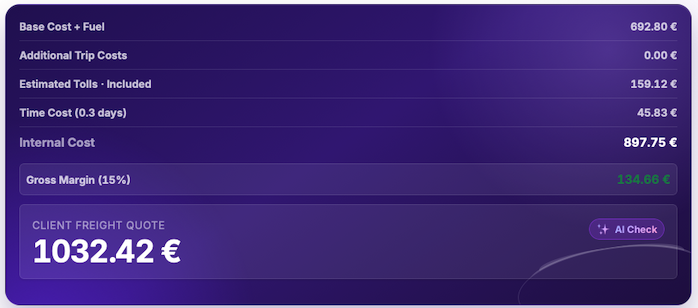
LogicCalc is a planning tool. Always verify operational, legal and contractual requirements for the actual transport.