Calculate vehicle kilometres
Build the complete route, including relevant empty positioning, so the estimate uses the movement actually planned.

Estimate the greenhouse-gas emissions associated with a road freight route. Use route distance and the selected vehicle assumptions to create a practical CO₂ result for internal comparison, customer reporting and ESG planning.
A simplified route estimate multiplies vehicle activity by an emission factor. The usefulness of the result depends on consistent distance data and assumptions that match the vehicle and reporting purpose.
Build the complete route, including relevant empty positioning, so the estimate uses the movement actually planned.
Use the factor associated with the selected vehicle or the company reporting method.
Compare route scenarios and include the estimated emissions in the route summary or customer-facing PDF.
Estimated CO₂e = route distance × selected vehicle emission factor
Vehicle technology, fuel, load, distance, empty running, road conditions and the chosen reporting boundary can all affect the final emissions figure.
Use the calculated road distance for the complete movement rather than straight-line distance.
Include relevant deadhead travel when the reporting boundary covers the full vehicle movement.
Select assumptions that reflect the truck, fuel and operating profile used for the route.
Apply a consistent factor expressed per vehicle kilometre or another clearly defined reporting unit.
Keep weight, loading metres and utilisation visible because they help explain the efficiency of the movement.
Present the estimate with the calculation scope and assumptions instead of showing an unexplained CO₂ number.
Assume the complete vehicle route is 780 kilometres and the selected planning factor is 0.80 kilograms of CO₂e per vehicle kilometre.
The simplified result is 624 kilograms of CO₂e. A different vehicle, fuel, load factor or reporting standard can produce a different figure for the same route.
| Emissions input | Example value |
|---|---|
| Complete route distance | 780 km |
| Planning emission factor | 0.80 kg CO₂e/km |
| Loaded and empty movement | Included |
| Estimated route emissions | 624 kg CO₂e |
Illustrative estimate only. Use approved company or reporting-standard factors when the result is required for formal disclosure.
See how distance, empty positioning and vehicle assumptions change the estimated emissions.
Calculate from the same route used for cost and time planning instead of entering an unrelated distance.
Include a transparent estimate and its assumptions in the route summary when emissions information is requested.
Review CO₂, price, transit time, cargo space and vehicle utilisation as connected planning results.
CO₂e means carbon dioxide equivalent. It expresses different greenhouse gases as a comparable amount of carbon dioxide based on their warming effect.
Distance is a major input, but the emission factor should reflect the vehicle, fuel, operation and reporting method used for the estimate.
Include them when the reporting boundary covers the complete vehicle movement. Excluding deadhead travel can understate route activity.
Only when the methodology, emission factors, data quality and reporting boundary satisfy the relevant company or external standard. A planning estimate alone may not be sufficient.
This is a real LogicCalc workspace view. Use your own route, cargo, fleet and commercial settings for the actual calculation.
Open LogicCalc →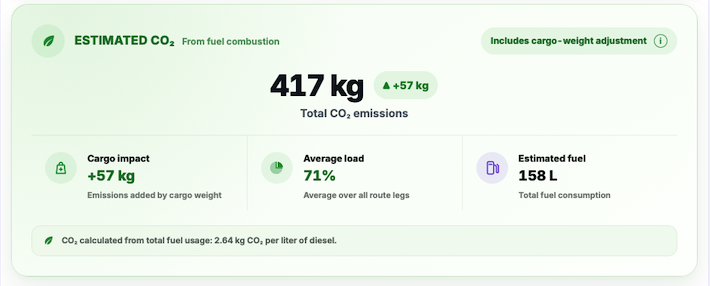
Explore route planning, transport pricing, cargo, driver-time and sustainability tools in one connected workspace.
Calculate the complete road route in LogicCalc, review the vehicle assumptions and include the CO₂ estimate with the same cost, time and cargo data.
CO₂ results are estimates. Formal reporting may require approved well-to-wheel or tank-to-wheel factors, fuel data, load allocation, empty-running rules and a documented methodology.