Calculate road driving time
Build the route and use the road travel estimate for the complete sequence of loading, delivery and intermediate stops.

Estimate how long a European truck route may take after driving periods, required pauses and daily rests are added to the road travel time. Use the result for planning, not as a substitute for legal compliance checks.
Map travel time alone is not the same as practical truck transit time. A usable estimate also needs scheduled pauses, daily rest periods and operational time at loading or delivery points.
Build the route and use the road travel estimate for the complete sequence of loading, delivery and intermediate stops.
Apply the planning assumptions for driving pauses and daily rest periods required during a longer movement.
Add operational buffers and compare the estimated arrival with the requested loading and delivery schedule.
Estimated transit time = road driving time + planned breaks + daily rests + loading and delivery buffers
Distance matters, but route duration also changes with average road speed, border and ferry conditions, mandatory rest planning and time spent at each stop.
Use the calculated route and road network rather than estimating time from straight-line distance.
Add the planned forty-five minute pauses that occur when continuous driving reaches the configured threshold.
Include daily rest periods when the route cannot be completed within one working day.
Allow realistic time for check-in, loading, paperwork, securing, unloading and waiting.
Consider timetable, check-in, border and terminal delays that are not fully represented by normal road speed.
Add contingency for traffic, parking availability, weather and other unpredictable route conditions.
Assume the route contains 17 hours and 20 minutes of road driving. The movement therefore needs planned driving pauses and cannot be completed in one daily driving period.
After adding three forty-five minute pauses, one daily rest and two hours for loading and delivery operations, the practical transit estimate is much longer than the map driving time alone.
| Time component | Example duration |
|---|---|
| Road driving time | 17 h 20 min |
| Driving pauses | 2 h 15 min |
| Daily rest | 11 h 00 min |
| Loading and delivery buffer | 2 h 00 min |
| Estimated transit time | 32 h 35 min |
Simplified example only. The correct legal schedule depends on the driver, operation, vehicle, applicable rules and real route conditions.
See when mandatory pauses and overnight rest make a same-day delivery unrealistic.
Keep driving time connected to every loading, delivery and intermediate point in the route.
Show why the operational duration differs from the navigation system driving estimate.
Use the same route-time result when estimating time-related operating cost and the client quotation.
No. Map time normally excludes mandatory pauses, daily rest, loading, unloading, waiting and many operational delays.
No. It provides a planning estimate based on configured assumptions. Dispatchers and carriers must verify the current rules and the drivers actual remaining hours.
Yes. Longer routes may span several driving days, so multiple rest periods and additional operational time may be necessary.
Traffic, weather, parking, border checks, ferry schedules, loading delays and temporary restrictions can all change the practical result.
This is a real LogicCalc workspace view. Use your own route, cargo, fleet and commercial settings for the actual calculation.
Open LogicCalc →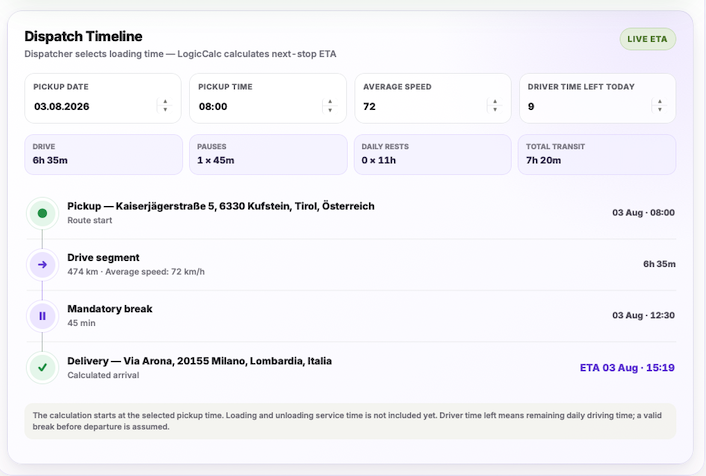
Explore route planning, transport pricing, cargo, driver-time and sustainability tools in one connected workspace.
Build the route in LogicCalc and compare road driving time with pauses, daily rests and operational buffers before committing to a delivery time.
Driver-time results are planning estimates and not legal advice. Verify current driving and rest rules, driver records, working-time limits, national exceptions and real operating conditions.